
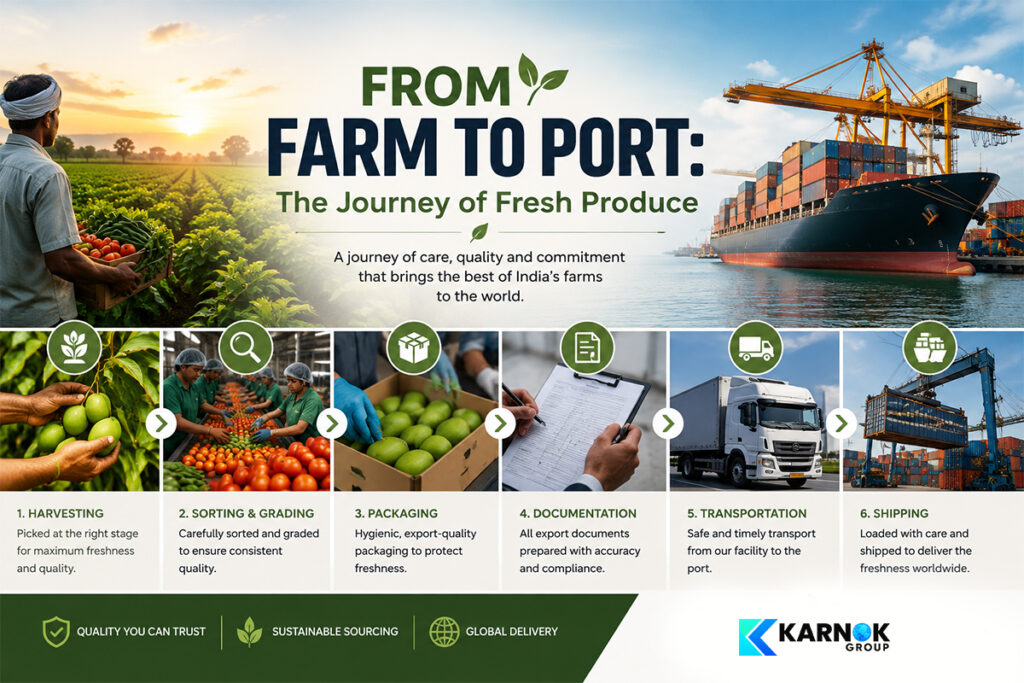
When international buyers receive a shipment of fresh mangoes, onions, pomegranates, bananas, tomatoes, garlic, or green chillies, the journey behind that shipment has already involved numerous steps.
Fresh produce does not simply move from a farm into a shipping container.
Before it reaches an international buyer, it passes through a carefully coordinated supply chain involving farmers, sourcing teams, quality checks, sorting, grading, packaging, documentation, transportation, and logistics coordination.
For agricultural exporters, managing these stages effectively is essential because fresh produce is different from conventional manufactured goods. Quality can change with time, temperature, handling, and transportation conditions.
So, what actually happens between the farm and the port?
Let’s take a closer look.
1. It Starts at the Farm
Every fresh produce export begins with agriculture.
Farmers cultivate and harvest the crops according to the growing cycle of each product. Depending on the commodity, production can be seasonal or available across different periods of the year.
Products such as:
- Mangoes
- Bananas
- Pomegranates
- Onions
- Tomatoes
- Garlic
- Green chillies
- Red chillies
- Turmeric
- Coriander
can have very different harvesting and handling requirements.
For an exporter, understanding the agricultural cycle is important for planning availability, volumes, and shipment schedules.
At Karnok Group, our supply approach focuses on working with Indian farmers and sourcing partners to connect agricultural produce with international buyers.
2. Harvesting at the Right Stage
Harvest timing can have a major impact on the quality of fresh produce.
Harvesting too early or too late can affect characteristics such as:
- Appearance
- Texture
- Taste
- Maturity
- Storage performance
- Transport suitability
The appropriate harvesting stage depends on the product and the requirements of the destination market.
For example, products intended for international transportation may need to be harvested at a stage that allows them to withstand handling and transportation before reaching the final market.
This is why harvesting is not simply about picking the crop—it is about preparing the produce for its next stage in the supply chain.
3. Collection and Initial Inspection
After harvesting, the produce is collected and moved through the sourcing network.
At this stage, an initial inspection can help identify produce that does not meet the required quality or buyer specifications.
The focus may include factors such as:
- Physical condition
- Size
- Color
- Maturity
- Visible damage
- Product uniformity
- General freshness
The exact requirements depend on the product and the buyer’s specifications.
Removing unsuitable produce early can help improve the consistency of the shipment that eventually reaches the packing stage.
4. Sorting and Grading
Once the produce reaches the appropriate handling or packing facility, sorting and grading become important steps.
Sorting involves separating produce based on its physical condition and suitability.
Grading involves categorizing the product according to defined characteristics such as size, appearance, quality, or buyer requirements.
For example, an importer purchasing onions may specify a particular size range and color, while a mango buyer may have requirements related to variety, size, maturity, and appearance.
This stage helps create a more uniform export shipment.
5. Quality Control
Quality control is one of the most important stages in the journey from farm to port.
Before products are packed for export, they should be checked against the relevant specifications agreed with the buyer.
Depending on the commodity, quality checks can consider:
Appearance → Size → Freshness → Uniformity → Physical condition → Product specifications
The objective is to ensure that the shipment is prepared according to the agreed requirements.
For international buyers, consistent quality control is particularly important because the products may travel long distances before reaching their destination.
6. Export Packaging
After sorting and quality checks, the produce is prepared for packaging.
Packaging requirements vary significantly between commodities.
Depending on the product and destination, packaging may include:
- Export cartons
- Mesh bags
- Jute bags
- Plastic crates
- Corrugated boxes
- Customized packaging
Packaging needs to balance several considerations.
It should provide appropriate protection during handling and transportation while also meeting the buyer’s commercial and presentation requirements.
For example, packaging suitable for onions may not be appropriate for delicate fruits.
The right packaging is therefore part of the export strategy, not simply an afterthought.
7. Preparing the Export Shipment
Once the product has been packed, the shipment is prepared for dispatch.
At this stage, the exporter coordinates information such as:
- Product quantity
- Number of packages
- Packaging format
- Buyer requirements
- Shipment details
- Destination
- Transport arrangements
- Required documentation
Accurate coordination is important because multiple parties may be involved in an international agricultural shipment.
A small documentation or coordination error can potentially cause unnecessary delays.
8. Export Documentation
International agricultural shipments require appropriate documentation.
Depending on the product, destination, transaction, and applicable regulations, documentation can include commercial and shipping documents as well as relevant agricultural or phytosanitary documentation.
The exporter needs to ensure that the required documentation is prepared and coordinated correctly.
For buyers, this is an important part of supplier evaluation.
A reliable agricultural exporter should understand that export compliance is just as important as product quality.
9. Moving the Produce From Facility to Port
After the products are packed and the shipment documentation is prepared, the goods are transported toward the relevant port or export point.
This stage requires careful coordination.
Fresh produce is time-sensitive, so unnecessary delays between packing and shipment should be avoided wherever possible.
The transportation plan depends on factors such as:
- Product type
- Shipment size
- Origin location
- Destination
- Port requirements
- Shipping schedule
- Handling requirements
The objective is to move the shipment efficiently while maintaining the required condition of the products.
10. Port and Shipment Coordination
Reaching the port is an important milestone, but the export process does not end there.
The shipment still needs to be coordinated with the relevant logistics and shipping processes before it begins its international journey.
The exporter may need to coordinate with:
- Transport providers
- Freight forwarders
- Shipping lines
- Customs-related stakeholders
- Port and logistics teams
- Importers or their representatives
Effective coordination helps keep the shipment aligned with the planned schedule.
11. The Journey to the International Market
Once the shipment leaves India, the produce begins its international journey.
Depending on the destination and transportation method, the products may travel by sea or air.
During this stage, the shipment’s handling and transportation conditions become particularly important.
The goal is to ensure that the produce arrives at the destination in the condition expected by the buyer.
This is why planning the supply chain before the product reaches the port is so important.
12. From Port to the Buyer’s Market
After reaching the destination country, the shipment goes through the applicable import procedures before continuing to the buyer’s facility, warehouse, distribution center, or market.
The final stages may involve:
Arrival → Import procedures → Clearance → Local transportation → Buyer/warehouse → Distribution
At this point, the journey that began at an Indian farm reaches its next destination in the international food supply chain.
Why Every Stage Matters
The journey from farm to port involves many individual steps, but they are all connected.
A problem at one stage can affect the stages that follow.
For example:
Poor harvesting decisions
↓
Inconsistent product quality
↓
More sorting and rejection
↓
Packaging challenges
↓
Shipment delays or commercial issues
On the other hand, good coordination across the supply chain can create a smoother export process.
Responsible sourcing
↓
Proper harvesting
↓
Sorting & grading
↓
Quality control
↓
Appropriate packaging
↓
Documentation
↓
Logistics coordination
↓
International shipment
This is what makes agricultural exporting a supply-chain business rather than simply a buying-and-selling activity.
The Importance of Communication With International Buyers
An exporter’s responsibility is not limited to preparing the physical shipment.
Communication with the buyer is equally important.
Before an order is finalized, the exporter and buyer should have a clear understanding of:
- Product specifications
- Quantity
- Packaging
- Quality expectations
- Shipment schedule
- Destination
- Documentation
- Commercial terms
Clear communication helps reduce misunderstandings and gives both parties a better understanding of what is expected.
For long-term international trade relationships, this transparency can be just as valuable as competitive pricing.
How Karnok Group Approaches Fresh Produce Exports
At Karnok Group, we focus on connecting Indian agricultural produce with international markets.
Our product range includes fresh fruits, vegetables, and spices, including mangoes, bananas, pomegranates, onions, tomatoes, garlic, green chillies, red chillies, turmeric, and coriander.
Our approach involves coordinating sourcing, product selection, quality-oriented preparation, packaging, documentation, and logistics to support international supply requirements.
We believe that successful agricultural exporting requires more than finding a buyer and shipping a product.
It requires a supply chain built around quality, communication, responsible sourcing, and reliable execution.
What International Buyers Should Look for in an Exporter
If you are an importer looking to source fresh produce from India, consider asking potential suppliers:
✔ Do they understand the product?
An exporter should be able to clearly explain the varieties, specifications, availability, and handling requirements of the products they supply.
✔ Can they maintain consistent quality?
One good shipment is useful, but long-term consistency is more important.
✔ Do they understand export documentation?
Proper documentation is critical for international agricultural trade.
✔ Can they coordinate packaging and logistics?
The exporter should understand your packaging and shipment requirements.
✔ Do they communicate clearly?
Reliable communication helps prevent avoidable problems.
✔ Can they support long-term supply?
If you are looking for a recurring supplier, discuss expected volumes and purchasing schedules from the beginning.
From an Indian Farm to a Global Buyer
Every box of fresh produce exported from India represents a much larger journey.
It begins with a farmer and continues through harvesting, collection, sorting, grading, quality checks, packaging, documentation, transportation, port coordination, and international shipping.
For an exporter, the responsibility is to coordinate these stages effectively.
For an international buyer, understanding this journey can help when evaluating potential suppliers and building long-term sourcing relationships.
At Karnok Group, our goal is to make that journey as organized and dependable as possible—connecting quality Indian agricultural produce with buyers across global markets.
Conclusion
The journey of fresh produce from farm to port involves much more than transportation.
It is a carefully coordinated process where agriculture, quality control, packaging, documentation, logistics, and communication all come together.
For international buyers, choosing an exporter who understands this complete journey can make a significant difference to the reliability of their supply chain.
And for exporters, the goal should always be the same:
Start with quality at the farm and maintain that focus all the way to the port—and beyond.
Looking to Source Fresh Produce From India?
Karnok Group works with international buyers looking for fresh fruits, vegetables, and spices from India.