
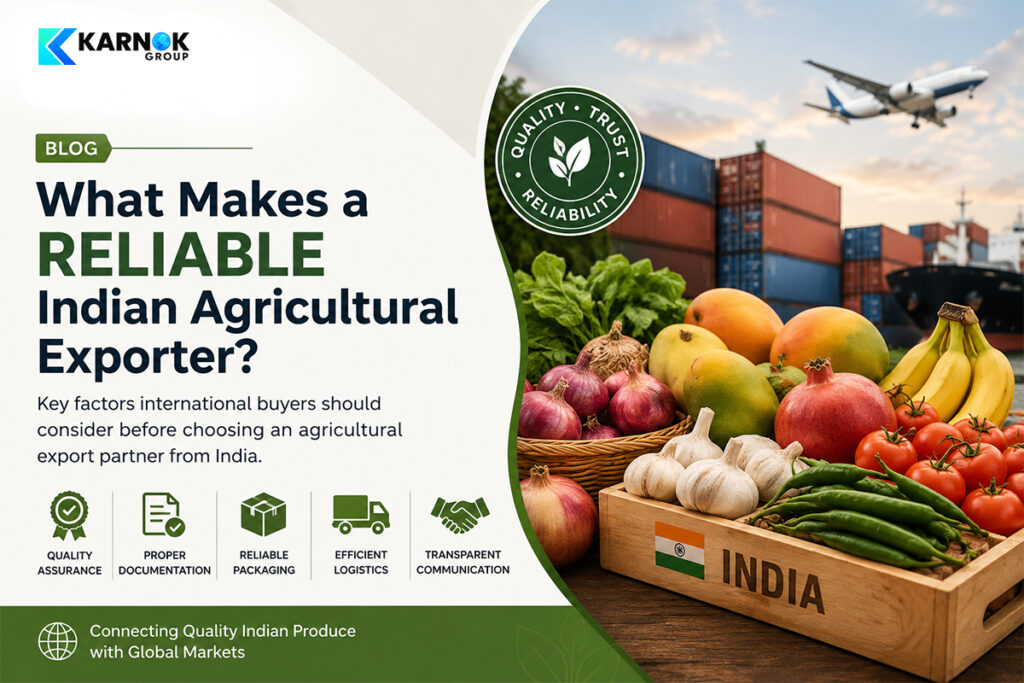
India is one of the world’s major agricultural producing countries, offering a wide range of fresh fruits, vegetables, and spices to international markets. For importers, wholesalers, distributors, retailers, and food businesses, sourcing from India can provide access to diverse products and competitive supply opportunities.
However, choosing the right agricultural exporter is about much more than finding a supplier with the right product and price.
Fresh agricultural products are highly sensitive to quality, handling, timing, documentation, packaging, and transportation. A mistake at any stage can affect the condition of the shipment and ultimately create problems for the buyer.
So, what makes an Indian agricultural exporter reliable?
A dependable exporter should combine consistent product quality, proper export documentation, responsible sourcing, effective logistics, transparent communication, and the ability to understand the specific requirements of international buyers.
In this article, we explore the key factors buyers should consider when selecting an agricultural exporter from India.
1. Consistent Product Quality
Quality consistency is one of the most important factors when choosing an agricultural exporter.
Fresh produce can naturally vary in size, appearance, maturity, texture, and other characteristics. A professional exporter needs to have processes in place to select, sort, grade, and prepare products according to the buyer’s requirements.
For example, an international buyer sourcing onions may have specific requirements regarding:
- Size
- Variety
- Color
- Quality grade
- Packaging
- Quantity
- Destination requirements
Similarly, buyers sourcing mangoes, bananas, pomegranates, tomatoes, garlic, green chillies, or other products may have their own specifications.
A reliable exporter should therefore focus on consistent supply rather than simply supplying whatever is available at the time of order.
2. Strong Quality Control from Farm to Shipment
Quality control should not begin when the products reach the export warehouse.
It starts much earlier.
The agricultural supply chain can involve farmers, collection points, sorting facilities, packhouses, transportation providers, and export documentation teams.
A reliable exporter understands that every stage can influence the final shipment.
The general process may include:
Farm Selection → Harvesting → Collection → Sorting → Grading → Quality Inspection → Packaging → Documentation → Transportation → Shipment
Each stage needs appropriate attention to maintain the condition and quality of the produce.
For international buyers, this is particularly important because the products may travel thousands of kilometres before reaching their destination.
3. Proper Export Documentation
International agricultural trade involves more than physically moving products from one country to another.
Export documentation is an essential part of the process.
Depending on the product, destination country, and transaction requirements, documentation may include commercial invoices, packing lists, certificates, shipping documents, and applicable agricultural or phytosanitary documentation.
A professional exporter should understand the documentation requirements applicable to the shipment and coordinate the necessary processes properly.
For buyers, this can significantly reduce delays and avoid unnecessary complications during import procedures.
Good documentation is not simply administrative work—it is an important part of reliable international trade.
4. Understanding International Buyer Requirements
Every international market can have different expectations.
A buyer in the Middle East may have different packaging or product preferences from a buyer in Europe. Similarly, requirements can differ depending on whether the customer is a wholesaler, distributor, supermarket supplier, food processor, or another type of business.
A reliable exporter should therefore ask the right questions before confirming an order.
These may include:
- What product specification do you require?
- What quantity do you need?
- What packaging format do you prefer?
- What is your destination port?
- What are your delivery requirements?
- Are there specific quality or compliance requirements?
- Do you require private-label or customized packaging?
This approach allows the exporter to prepare the shipment around the buyer’s actual requirements rather than using a one-size-fits-all model.
5. Reliable Packaging
Packaging plays a major role in fresh produce exports.
The purpose of export packaging is not simply to make the product look attractive. It must also help protect the produce during handling, transportation, storage, and distribution.
Depending on the product and destination, exporters may work with packaging formats such as:
- Cartons
- Mesh bags
- Jute bags
- Plastic crates
- Export-grade boxes
- Customized packaging
The appropriate packaging should be selected based on the product characteristics, transportation conditions, buyer requirements, and destination market.
For example, packaging requirements for fresh mangoes may differ considerably from those for onions or garlic.
6. Efficient Logistics and Shipment Coordination
Fresh agricultural products are time-sensitive.
Once an order is confirmed, multiple activities need to happen within the appropriate timeframe—from product sourcing and preparation to packaging, documentation, transportation, and shipment.
This makes logistics coordination an important part of agricultural exporting.
A reliable exporter should be able to coordinate the different stages involved in moving the shipment from the sourcing location to the destination.
For international buyers, effective logistics management can mean:
Better planning → Fewer avoidable delays → Better shipment coordination → More predictable supply
The exporter does not necessarily control every part of the logistics chain, but they should be capable of coordinating the process effectively.
7. Transparent Communication
One of the simplest ways to evaluate an exporter is to look at how they communicate.
A reliable supplier should provide clear information about:
- Product availability
- Specifications
- Quantity
- Pricing
- Packaging
- Production or sourcing timelines
- Shipment schedules
- Required documentation
International trade often involves buyers and suppliers operating in different countries and time zones. Clear communication therefore becomes even more important.
If there is a change in availability, quality, schedule, or logistics, the buyer should be informed rather than discovering the problem at the last moment.
Transparency builds confidence.
8. Ability to Handle Different Order Volumes
International buyers can have very different purchasing requirements.
One customer may require a smaller trial shipment, while another may regularly purchase larger commercial quantities.
A capable agricultural exporter should have access to a suitable sourcing and supply network to accommodate different requirements where possible.
For buyers, it is useful to ask:
Can this supplier consistently fulfil my required quantity—not just once, but over multiple shipments?
Long-term reliability is ultimately demonstrated through consistent execution over time.
9. Responsible Sourcing and Farmer Relationships
India’s agricultural export industry depends heavily on its farming communities.
A responsible exporter should understand the importance of maintaining strong relationships with farmers and sourcing partners.
Working closely with producers can help exporters better understand:
- Harvest cycles
- Seasonal availability
- Product characteristics
- Farming practices
- Expected production volumes
- Quality considerations
At Karnok Group, our approach is centered around working with Indian farmers and sourcing partners while focusing on quality, responsible agricultural practices, and dependable supply.
The objective is not simply to purchase produce and export it. It is to build a supply chain that can support quality, consistency, and long-term relationships.
10. Product Knowledge Matters
A reliable agricultural exporter should know the products they are selling.
For example, exporting mangoes requires an understanding of varieties, seasonality, maturity, handling, packaging, and destination requirements.
The same principle applies to products such as:
- Onions
- Tomatoes
- Garlic
- Green chillies
- Bananas
- Pomegranates
- Red chillies
- Turmeric
- Coriander
An exporter with strong product knowledge can communicate more effectively with buyers and help them select specifications appropriate for their market.
11. Financial and Commercial Reliability
Price is naturally an important consideration in international trade.
However, the lowest quotation does not always represent the best commercial opportunity.
Buyers should also consider:
- Product consistency
- Packaging quality
- Documentation
- Shipment coordination
- Communication
- Order fulfilment
- Payment terms
- Long-term supply capability
A slightly different price can become insignificant if poor quality, delays, documentation problems, or inconsistent supply create additional costs for the buyer.
The objective should be to identify an exporter offering overall commercial value, not simply the lowest initial price.
12. A Long-Term Approach to Buyer Relationships
A reliable exporter should view international buyers as long-term business partners rather than one-time transactions.
This means understanding the buyer’s business, maintaining consistent communication, learning from shipment feedback, and continuously improving the supply process.
For an importer, a strong supplier relationship can eventually provide benefits such as:
- More predictable sourcing
- Better understanding of product requirements
- Easier order coordination
- Improved communication
- Greater confidence in future shipments
This is particularly valuable for businesses that depend on regular agricultural imports.
How Should Buyers Evaluate an Indian Agricultural Exporter?
Before placing an order, international buyers can use a simple checklist.
Ask the exporter:
1. What products do you currently supply?
Understand their actual product range rather than relying only on a website.
2. Which markets do you serve?
Experience with international shipments can be an important indicator of operational capability.
3. What product specifications can you provide?
Ask about size, variety, grade, packaging, quantity, and other relevant specifications.
4. How is quality controlled?
Understand how the products are selected, sorted, graded, and prepared.
5. What documentation is provided?
Confirm the documents applicable to your shipment and destination.
6. What packaging options are available?
Discuss packaging before confirming the order.
7. What is the expected shipment timeline?
Clarify preparation, dispatch, and shipping schedules.
8. Can you provide samples or product information?
Where practical, evaluate the product before committing to larger volumes.
9. Can you support recurring supply?
If you are looking for a long-term supplier, discuss your expected purchasing frequency and volume.
Why Reliability Matters More Than a Single Shipment
A successful first shipment is a positive sign, but it does not necessarily prove long-term reliability.
The real test is whether an exporter can maintain a similar level of service across multiple shipments.
For international buyers, the ideal agricultural export partner is one who can combine:
Product Quality + Consistency + Documentation + Packaging + Logistics + Communication + Long-Term Commitment
These elements work together to create a dependable export relationship.
Karnok Group: Connecting Indian Agricultural Produce With Global Buyers
At Karnok Group, our focus is on connecting quality Indian agricultural produce with international markets.
We work across fresh fruits, vegetables, and spices, including products such as mangoes, bananas, pomegranates, onions, tomatoes, garlic, green chillies, red chillies, turmeric, and coriander.
Our approach focuses on responsible sourcing, quality-oriented supply, export preparation, packaging, logistics coordination, and communication with international buyers.
For us, agricultural exporting is not only about moving products from India to another country. It is about building a supply chain that international buyers can rely on.
Whether you are an importer, wholesaler, distributor, retailer, or food business looking to source agricultural products from India, understanding your requirements is the first step toward developing a successful supply relationship.
Final Thoughts
Choosing an Indian agricultural exporter should not be based on price alone.
A reliable exporter should demonstrate consistent quality, proper documentation, responsible sourcing, suitable packaging, effective logistics coordination, transparent communication, and the ability to meet buyer requirements.
For international buyers, taking the time to evaluate these factors before placing an order can help reduce supply-chain risks and establish stronger long-term business relationships.
India offers enormous opportunities for global agricultural sourcing. The key is finding an export partner who can turn that opportunity into a consistent and dependable supply relationship.
Looking for an Agricultural Exporter from India?
Talk to Karnok Group about your fresh fruits, vegetables, and spice sourcing requirements.